


Impacts of Transporting Horses: Sideways vs. Face-Forward in a Horse Box
- Grace O'Rourke
- Dec 24, 2024
- 3 min read

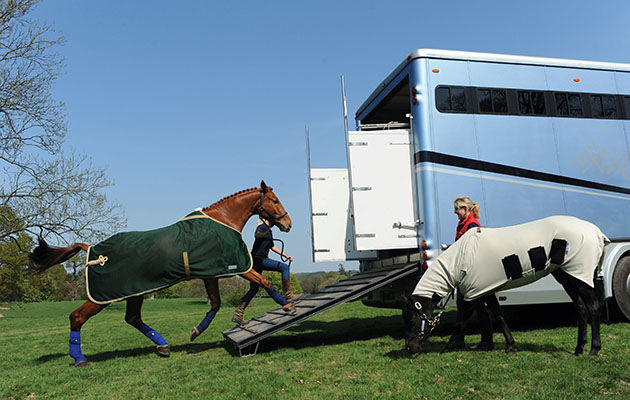
I often wonder the effects travel has on a horse and if it affects performance. You would think that the position in which a horse is transported within the horse box—sideways or face-forward—could influence its musculoskeletal health, biomechanics, and overall physical condition. While there is very little research on the effects of different transport orientations, I was curious to see what I could find in relation to stresses and forces on the horse's body in sideways versus face-forward transport.
Sideways Transport: Effects on Equine Biomechanics
Sideways transportation involves positioning the horse with its body parallel to the length of the horseboxx, typically with the head directed towards one side. While this arrangement is common, it presents distinct biomechanical challenges.
Lateral stability and musculoskeletal strain:
One of the primary concerns with sideways transport is the increased lateral movement that horses experience during travel. The horse's body is subjected to centrifugal forces, particularly during turns, accelerations, or decelerations. These forces act across the horse’s body, placing strain on the lateral stabilisers of the musculoskeletal system. This pressure is always the same side, as the fittings for partitions are usually fixed for one direction (usually head facing left or passenger side).
Postural compensations and fatigue:
The sideways position limits the horse’s ability to engage in natural postural adjustments. Unlike forward-facing positions, where the horse can shift weight symmetrically, sideways positioning forces the horse into a more constrained posture. As a result, the horse may experience localised muscle fatigue and stiffness, particularly in the shoulder, hindquarters, and neck regions. You would think that the horse is required to contract the muscles unevenly due to them being stood in the same direction, and breaking possibly requires the muscles of the right side to contract more than the left side.
For some horses, there could be the inability to balance properly in the sideways position, which could also result in reduced efficiency of the horse's locomotor system, potentially leading to delayed recovery post-transport. So does this mean that horses transported sideways would exhibit higher levels of muscle stiffness and prolonged recovery times compared to those transported face-forward?
Face-Forward Transport: Mechanical Advantages and Stability
In contrast to sideways transportation, face-forward positioning places the horse with its head directed in the same direction as the travel. This arrangement, you would think, would be considered to offer greater biomechanical stability due to the reduced lateral forces acting on the body during travel.
Possible reduced lateral forces and enhanced stability
Face-forward transport minimises the lateral sway experienced by the horse, particularly during acceleration. As the horse faces the direction of travel, the body is subjected to forward-directed forces, which are more aligned with the horse's natural posture.
It would seem that face-forward positioning reduces lateral forces on the horse’s body, as the horses' posture in the face-forward position also allows for a more symmetrical weight distribution, reducing the likelihood of muscle imbalances and fatigue. However, in a study by Waran et al. (1996) relating to "Effects of transporting horses facing either forwards or backwards on their behaviour and heart rate", the horses seemed to find being transported facing backwards less physically stressful compared to when they were facing forwards.
Biomechanical alignment and muscle efficiency
In the same study by Waran et al. (1996), it was also noted that horses carry their necks higher when facing forward. So while you would think the face-forward position facilitates a more natural positioning, this high neck carriage could put the vertebrae of the neck and back into an unatural extension.
Factors to consider when Comparing the Biomechanical and Musculoskeletal Effects: Sideways vs. Face-Forward
As there is little or no research on the differences of travel positions, here are some possible biomechanical and musculoskeletal differences between the two positions:
Muscle strain: Muscle strain seems like it would be uneven when traveling laterally as the horse is always facing in the same direction. You would think that the breaking action would cause uneven fatigue in the horse's muscles laterally, as its always the right side being propelled forward.
Postural Alignment: The sideways position seems to limit the horse’s ability to make compensatory adjustments. Is there the ability for the horse to engage its core, or is the force directed on to the limbs in a lateral position?
Recovery Time: As there is no research in this area, it is difficult to say; however, you would think forward facing would benefit the horse more, as they are in a more natural position to distribute weight between the left and right sides as the vehicle breaks or accelerates.
References
Waran, N.K., Robertson, V., Cuddeford, D., Kokoszko, A. and Marlin, D.J. (1996), Effects of transporting horses facing either forwards or backwards on their behaviour and heart rate. Veterinary Record, 139: 7-11. https://doi.org/10.1136/vr.139.1.7


Comments